Is your business missing from local searches? Our local visibility audit reveals exactly why customers can’t find you on maps and AI assistants.
As a business owner, you know the frustration of hearing a customer say, “I tried to find you online but couldn’t.” You have a great reputation, your service is top-tier, and your team is busy every day. Yet when someone searches for a local service on their phone, your competitors show up instead. This is exactly why we built the Competitive Findability Report, our local visibility audit. It isn’t a generic health check. It’s a diagnostic that uncovers the gaps that keep you from being seen by search engines and AI assistants.
Why ‘Can’t Find You’ Is Three Different Problems
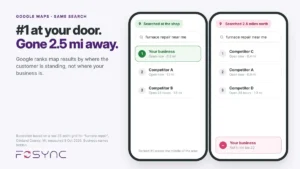
When customers can’t find you, they usually aren’t hitting one problem but three. First, there’s the map gap. Google Maps doesn’t rank you only by your business address; it ranks you based on where the person searching is standing. Google itself says local results are based mainly on relevance, distance and prominence. If you aren’t visible in the neighbourhoods you serve, the people who live there won’t see you.
Second, there’s the AI recognition gap. More and more customers ask ChatGPT, Gemini or Perplexity for recommendations. These assistants piece answers together from what they can read about you. If they can’t find clear, consistent facts about your business, they are far less likely to name you.
Finally, there’s data inconsistency. If your hours on your website differ from your Google Business Profile or your social pages, your business becomes harder for Google and assistants to trust, and a competitor with consistent information becomes the safer recommendation.
The Map Grid: 25 Points Across Your Service Area
Many owners check their ranking only from their own office. That’s a vanity metric. Your customers aren’t at your office; they’re spread across your service area. Our local visibility audit measures where you appear from 25 points across that area.
Here’s a real example from October 2026: an HVAC company in Oakland County, Michigan, searched as “furnace repair” from 25 spots, each about 1.2 miles (2 km) apart, centred on their office. In the middle three rows of the grid, they rank first everywhere. Two rows out, to the north and south, they don’t appear in the top 20 at all. Customers about 2.5 miles from the shop never see them.
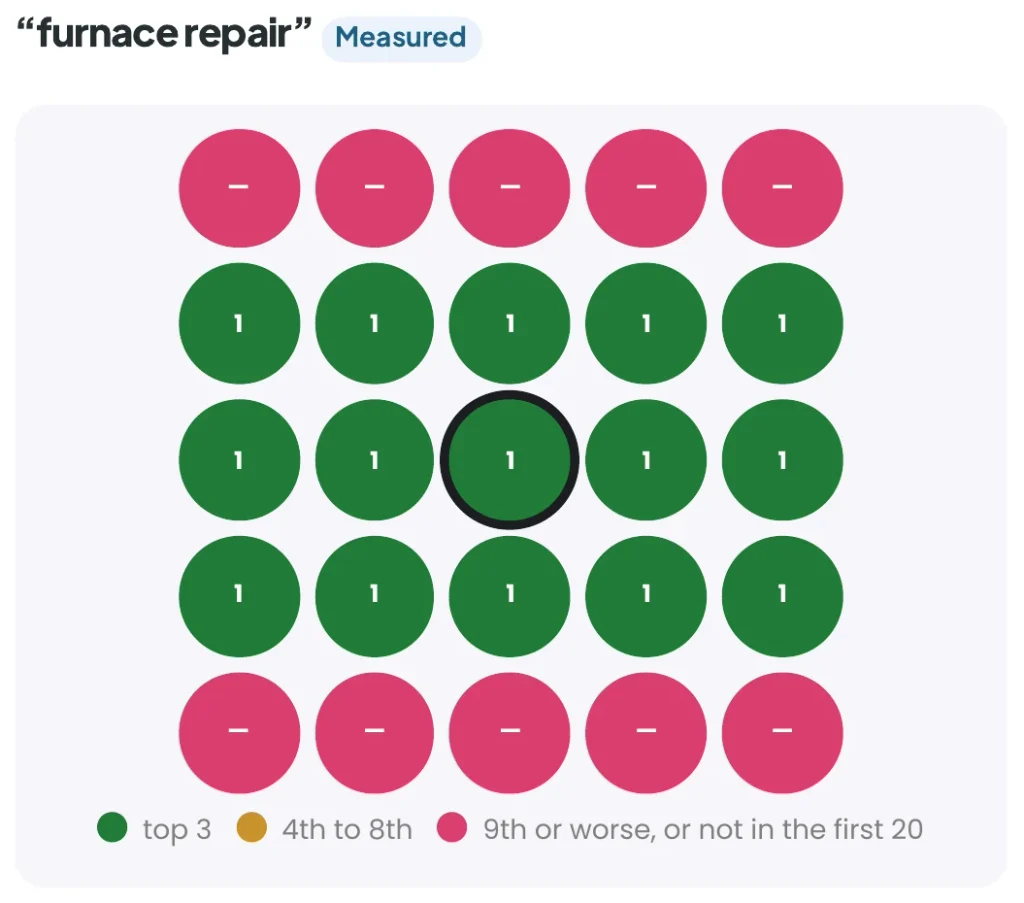
That’s what the grid shows you: where you’re winning, and exactly where you stop existing. It’s often why the phone rings from some neighborhoods and stays quiet from others, even though you serve them all.
The Assistant Test: 9 Questions Customers Actually Ask
AI assistants are changing how people find services. Instead of typing “HVAC contractor” into a search bar, a homeowner might ask their phone, “Who is the most reliable AC repair service near me that is open now?” or “Which local company can fix a furnace on a weekend?”
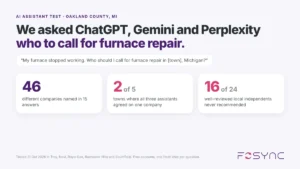
In the report, we ask ChatGPT, Gemini and Perplexity the same three buying questions each, with live web access, and store every answer word for word. Nine answers in total. For the same Oakland County company, which ranks first on Google Maps near its office, the result was 0 out of 9. One assistant named a competitor instead; the other two named no local business at all. Answers vary between runs, so we treat the count as a range rather than a fixed number.
The Facts Check: What Google and Assistants Read
Google and AI assistants compare what different sources say about you. Our audit checks your hours, phone number, address and reviews, and whether the business facts written into your website’s code, its schema, match what Google holds.
A common example: the same company’s website says it’s open 9 to 5, every day. Its Google listing says it’s open 24 hours. Neither is a typo on its own, but an assistant that finds both has nothing it can safely repeat. When your facts disagree, it becomes harder for Google and assistants to trust any of them.
How the Local Visibility Audit Becomes One Score
Everything we measure rolls up into one score, counted out of the points we could actually measure, plus a plain-language verdict. For the Oakland County company, that was 57 of 92 points, with the verdict “Losing customers now”.
The score is split into four pillars, so you can see where you’re strong and where you’re losing ground: Recommended by AI assistants, Found on Google, Turns visitors into customers, and Credible at a glance. That company scored well on credibility (17 of 20) and on Google (21 of 30), but only 7 of 25 on being recommended by assistants.
You also get the competitive part of the Competitive Findability Report: we name the local rival who is outperforming you, and show where they score higher. It isn’t about pointing fingers. It’s a benchmark: a real business in your area, serving the same customers, showing what “found” looks like and which gaps to close first.
A visibility score shows you why the phone is quiet, and which gaps are costing you bookings.
What to Do with a Low Score
If your local visibility audit shows a lower score than expected, don’t panic. A low score is a map of where to focus. It usually means your digital foundation needs updating: a website assistants can read, service areas clearly defined for search engines, and the same facts everywhere your business appears.
At FoSync, we fix these issues quickly. We believe speed is a feature, and we work to modernise your digital presence so you stop losing customers to competitors who are simply easier to find. Use your report to find the most critical gaps, and close them one by one.
Ready to see how you rank? Get your free Competitive Findability Report: enter your website on fosync.com and receive your score, map grid, and assistant results by email.